ISO 27001 Explained: From Controls to Business Value
Most organizations go for ISO 27001 mainly to get certified. But what it actually delivers often gets overlooked.
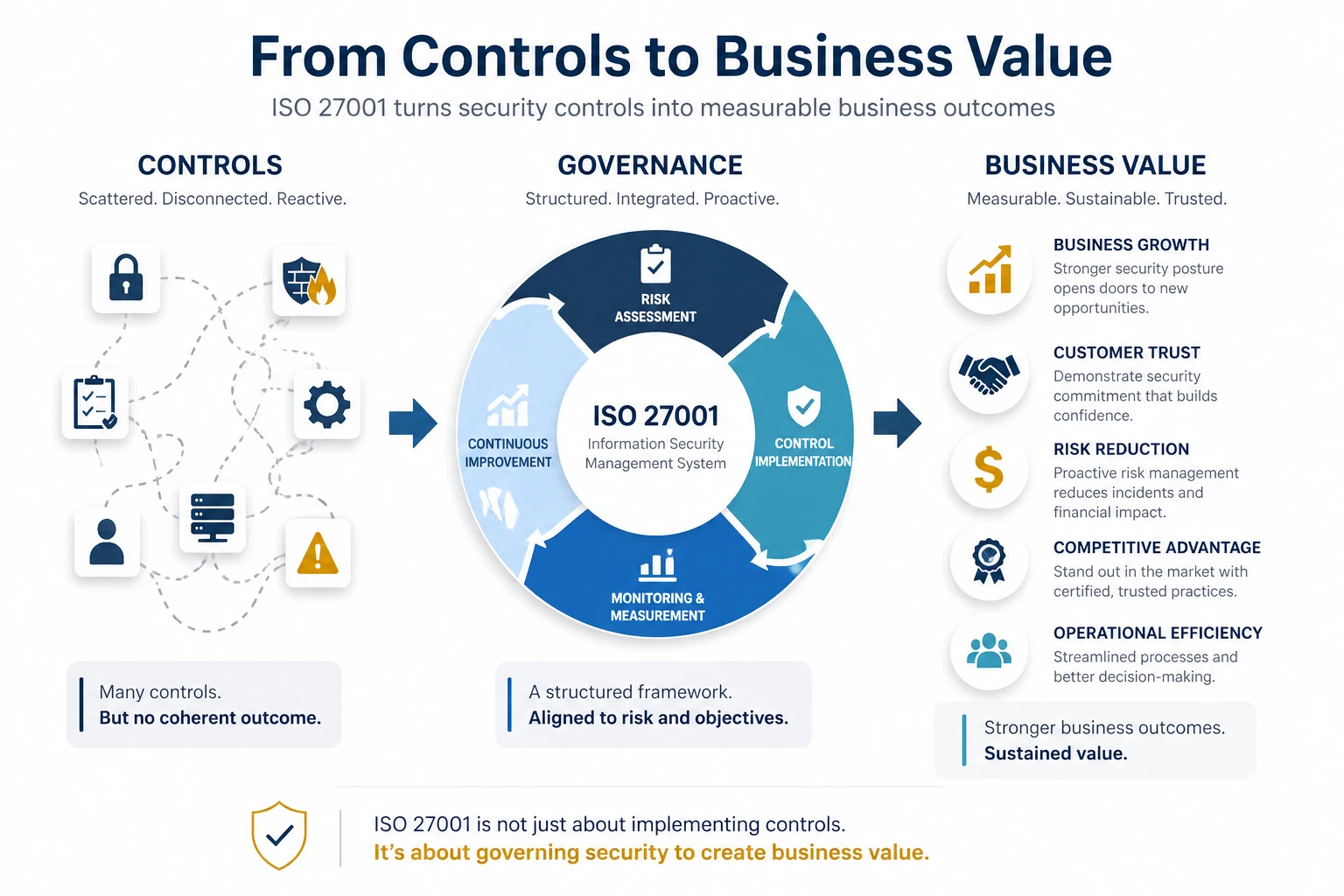
ISO 27001 isn’t just something you follow for compliance. It works more like a system that fits into how your business runs. When it’s done properly, it doesn’t just help during audits. It changes how risk is handled, how trust is built, and how operations grow over time.
Understanding the Structure: 30 + 93
At a basic level, ISO 27001 is divided into two parts.
There are 30 management system requirements, and then 93 annex controls grouped into organizational, personnel, physical, and technical areas.
This “30 + 93” structure is quite straightforward. One side focuses on how security is managed, while the other focuses on what controls are actually in place.
Management System Requirements (30)
These requirements define how security is governed across the organization.
They cover leadership involvement, planning, risk management, internal audits, and continuous improvement. The idea is simple. Security shouldn’t depend on individuals or one-time efforts. It should follow a consistent process.
In many organizations, policies and risk registers do exist. The problem is they are not reviewed regularly. Over time, they become outdated, and that weakens the system without anyone noticing.
Annex Controls (93 Total)
These controls define what needs to be implemented to manage risks properly.
Organizational Controls (37)
These are focused on governance, policies, and structure.
They help ensure decisions around security are not random. But in reality, policies often exist without clear ownership, which creates gaps when it comes to execution.
Personnel Controls (8)
These controls focus on people and their responsibilities.
Employees are expected to understand and follow security practices. Training is usually done, but without regular follow-up, awareness fades and the same mistakes happen again.
Physical Controls (14)
These relate to protecting facilities and infrastructure.
They are meant to prevent unauthorized access and reduce environmental risks. Many organizations put access controls in place, but monitoring and periodic checks are often missed.
Technical Controls (34)
These are the controls that protect systems and data.
They include access control, monitoring, encryption, and system-level protections. Most companies implement them, but regular review is often missing, which reduces their actual effectiveness.
Beyond the Structure: What ISO 27001 Really Does
Each part of ISO 27001 focuses on a different area like governance, risk, or controls.
But when everything is put together, it creates a system that keeps running continuously. It’s not something that only comes into focus during audits.
The Real Problem Organizations Face
ISO 27001 rarely fails because controls are missing.
More often, the issue is how those controls are used.
Controls are not followed consistently.
Activities happen only when audits are near.
Ownership is unclear in many cases.
So the gap is not compliance. It’s execution.
From Compliance to Business Advantage
Organizations that move beyond basic implementation start seeing actual value.
Builds Customer Trust
ISO 27001 shows that security is structured and risks are actively managed. This helps build confidence with enterprise clients, partners, and regulators.
Accelerates Sales Cycles
Customers often ask how their data will be protected. ISO 27001 provides a clear answer, which helps reduce delays during approvals and due diligence.
Improves Risk Visibility
Risks are identified, reviewed, and handled in a structured way. This makes decision-making easier and reduces unexpected issues.
Creates Operational Discipline
Processes become defined and repeatable. Monitoring becomes ongoing instead of occasional. Organizations shift from reacting to problems to managing them in advance.
Reduces Dependency on Individuals
Without structure, security depends on people.
With ISO 27001, responsibilities are clearly assigned and processes are followed consistently. This brings stability and makes scaling easier.
Supports Growth and Expansion
As organizations grow, complexity increases.
ISO 27001 provides a structured approach that helps manage that growth without losing control over security.
The Bigger Shift
ISO 27001 isn’t about ticking off requirements.
It’s about building a system that keeps running, adapts when things change, and supports business growth over time.
Final Thought
Security is no longer limited to IT. It has become a core business requirement.
Organizations that succeed with ISO 27001 don’t treat it as a checklist or something done only for audits. They use it as a system to manage risk, build trust, and support long-term growth.